Category: devices

  • XTEINK update! It’s a USB-C Comeback

    XTEINK USB C

    It seems the war everyone was on against Pogo plugs was loud enough that XTEINK heard it and responded. XTEINK has shared that it will now make both pogo and USB C devices, in response to the outpouring of emotion against Pogo and for USB C. XTEINK’s reddit post

    Hey everyone,

    Thanks again to everyone who joined the discussion around Pogo and USB-C. I’ve spent a lot of time reading through the comments and bringing the feedback back to our team.

    One thing became pretty clear: some of you really value having the thinnest and lightest device possible, while others would rather accept a little more thickness for USB-C and a more convenient everyday experience.

    We don’t think everyone should have to make the same trade-off.

    So we’ve decided to work in both directions.

    We’ll keep exploring thinner and lighter eReaders, while also working toward bringing USB-C back as an option in future products.

    That work has already started.

    Thanks for being so direct with us. Please keep the feedback coming.

    — Henry^^

    This reads like we’ll have both pogo and USB C devices, which is bound to please some and annoy others. I guess you can’t keep everyone happy. As for me, I just want to read.
     

  • A dual screen EINK reader? Meet the MoLink

    MoLink SE

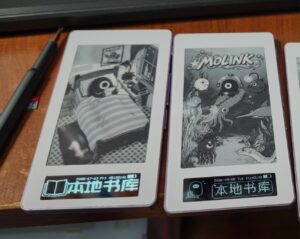
    With a lot of noise around the recent Apple event and Apple’s folding iPhone, the iPhone Duo, here’s an interesting dual screen EINK device out of China. It’s called the MoLink SE. The MoLink is an open-source community built EINK microreader. Built for DIYers and hobbyists, it’s almost impossible to get, you need to follow the developer on WeChat and they release limit batch runs. The most recent drop was Sept 8th, and another drop is expected end of September. As far as I know, this is the only dual screen microreader.

    The main screen is a 4.27″ EINK panel at 227PPI. The second screen is a 2.05″ OLED display. It reminds me a bit of old style Barnes & Noble Nook devices. The secondary screen is for reading stats, time, and is, from all reports, responsive to touch. You may be wondering what an OLED screen does for battery life, well the MoLink has a 4000mAh battery, which is the highest capacity I have seen to date in the microreader category. Charging is by USB C and memory expansion is using microSD.

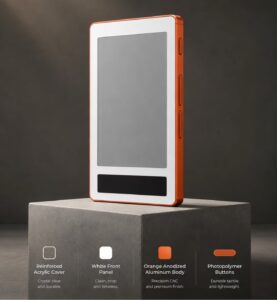
    Despite the hobbyist nature of the device, there’s no warranty or after sales support, MoLink does appear to be moving more into the professional grade. They recently shared an image of an Aluminum version that looks amazing and very premium. This is being broadl described as the MoLink SE.

    MoLink SE CNC Aluminum Model

    The MooLink uses its own operating system. It’s not Android, which surprised me given the secondary OLED display. There’s also no word on the processor. But I have to think it’s not ESP32 given everything it is driving.

    On the price side, the price ranges from RMB399-499 and there is a developer edition that sells for slightly higher. The aluminum MoLink SE edition will no doubt retail for more. Don’t expect the MoLink to pop up on AliExpress anytime soon, you’ll need a friend in China if you want to get this unique device that has come out of the China DIY community.


  • Murphy M4, a sub $50 microreader

    Murphy M4

    With all the excitement for XTEINK and EEGOREAD, there’s another microreader out there that’s worth a look. It’s the Murphy M4. The Murphy M4 starts at sub $50 for a 3.7″, frontlight, touchscreen eReader. That said, it pays to be diligent when trying to buy the Murphy as there are non-front light models and all sorts of device combinations. It runs its own OS, MurphyOS which feels a bit like a Crosspoint fork, although Crosspoint isn’t fully supported. If you do get a Murphy M4, you can flash CrossLink to the Murphy M4 over at the Crosslink website.

    What makes the Murphy M4 a bit unique in the space is it’s not brand. There’s no Murphy company making M4’s. It’s a genuine hobbyist device coming out of the China maker community. So if you get one, be prepared for it to be a bit more rough around the edges vs other devices on the marker. If you own a 3D printer, like to hack, code, or tinker then the Murphy M4 is your kind of device.

  • iReader Tango 2S Full Specs Revealed

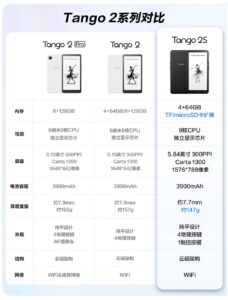
    iReader Tango 2S Specs

    More details are coming to light about the iReader Tango 2S. This is a 5.84″ EINK EReader and seems to be positioned as iReaders budget-entry level Tango device.

    • Memory: 4 GB RAM + 64 GB storage microSD card expansion
    • Processor: 8‑core CPU (processor unknown)
    • Display: 5.84‑inch Carta 1300 e‑ink screen,
    • Resolution: 300 PPI resolution (1576 × 788 pixels)
    • Battery: 3900 mAh capacity
    • Dimensions & Weight: ≈ 7.7 mm thick, ≈ 147 g lightweight
    • Design: Flat body with 4 physical buttons and 1 touch button
    • Connectivity: Wi‑Fi only

    We previously shared that the Tango 2S will retail for USD$245. It’s available to now in China.

  • A Full Color Microreader for under $50 Tickey could be the ticket

    TICKEY Color Display

    I’m always VERY suspicious of Kickstarter and this post is no way an endorsement of Kickstarter or the product, but it’s interesting enough to share out with the microreader community. I also broke my cardinal rule of never supporting Kickstarter and personally backed this, even though I have a lot of doubts.

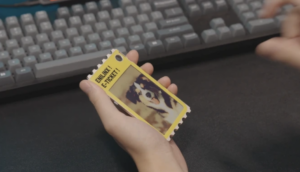
    The ENILINX Tickey is 3.7″ full color EINK device. An opensource full color microreader for under $50 with USB C? Will Enilinx be able to deliver on what seems an impossible ask? They claim, with a lot of caveats mind you, that it will support 48+ colors thanks to a Modos custom EINK display (for comparison, most color displays a 4-6). I own the XTEINK Nano and it is barely passable at color. I also have the Kobo Clara Color and Remarkable Move, but the colors are so muted. This means I have (and you should too) really low expectations on the color reproduction despite the Tickey kickstarter images.

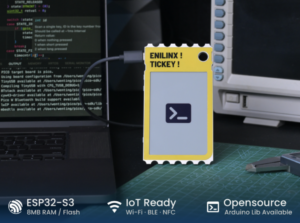
    What sparked my attention is that it’s an ESP32-S3 device with 8Mb on board and fully open, making it potentially great for custom firmware.

    Tickey EINK microreader

    Design wise, it’s made of CNC aluminum, at 3.8mm thin and 45g in weight. It also has USB C, which is something I know many people obsess about. I think the aluminum body is a good idea, as it should make the device more rigid and less prone to breakage. But they kickstarter images of people using it as a bag tag make me worry – EINK screens are just not built for that kind of wear and tear.

    Other things to note is the faceplates are interchangeable.

    As with all Kickstarters, back at your own risk. Early bird orders are still around US$50 + tax and shipping, so assume around US$85 delivered to your door.  If, and this is always the big if on Kickstarters, Enilinx actually can deliver.

    If you’re interested in backing, here is the Enilinx Tickey Kickstarter (at your own risk).


  • XTEINK Unifying X4 Pro / X4 / X3 Series Operating Systems

    I know there’s many people who are not a fan of XTEINK’s XTOS and like to flash custom firmware. It seems XTEINK will be unifying their operating system under a new common design language, similar to what the stock X4 Pro experience. No date has been confirmed for this new design.

  • EEGOREAD P4 Pro Launches Friday 9/11 – Early Birds Only

    EEGO P4 Pro - 9/11 Launch

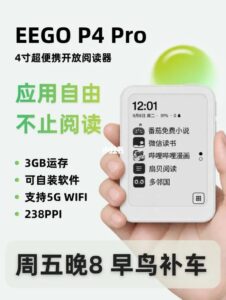
    The EEGOREAD P4 will start shipping Friday 9/11 to those that ordered during the early bird pre-order period. A reminder, the P4 Pro is has 3GB on board, supports 5G WiFi, and is a 238PPI screen. I did pre-order a P4 Pro, but not sure if my source will be able to get it to me. At the moment, I have an EEGOREAD A4 running Crosspoint and I continue to be impressed with this microreader.

    As with all EEGOREAD devices, the quantities are very limited. EEGOREAD really needs to work on their supply chain. They have been struggling to meet demand in China, have had QA issues (my 32GB microSD was dead on arrival), and as yet, there’s still no case or screen protector.

  • iReader Tango 2S launch Sept 8 – USD $245

    iReader Tango 2S

    The iReader Tango 2S is a new microreader from iReader. This is launching in China on September 8th 2026. It’s a 5.84″, 147g micoreader. The display is 300PPI and it’s a Carta 1300 EINK screen. Unfortunately, it’s not cheap at USD$245. I can’t confirm the specs, but this price point suggests it’s probably an Android-based device.

  • XTEINK X4C officially supports Crosspoint!

    The XTEINK X4C has not even been available for 24 hours and it already supports Crosspoint. Grab it from the Crosspoint Flash Tools page. I have found to get the best result, place your XTEINK X4C screen down with the pogo plug resting on top. This keeps the pogo plug secure during flashing. A reminder, only devices sold direct by XTEINK are unlocked. If you buy from 3rd party sellers, you may have a locked X4C.

  • XTEINK X4C available now! Officially Released

    The XTEINK X4 Classic aka X4C is officially available direct on XTEINK.com. Available in both black and gray. Priced at USD$79. I’d be quick if you want one, X4 Pro’s sold out and were on back order for several months. If you’re confused about which model to get, try one of the many buyer’s guides that are out there.

    Here’s the current XTEINK product roster.

    • X4 Classic (X4C)  (no light, non-touch)
    • X3 (no light, non-touch)
    • X4 Pro (front light, touchscreen)

    All XTEINK models now use pogo plugs.

    And as always, I would buy from XTEINK direct (or Amazon when the X4C is available there) as there’s no guarantee devices bought elsewhere will be unlocked.